01What the case actually does
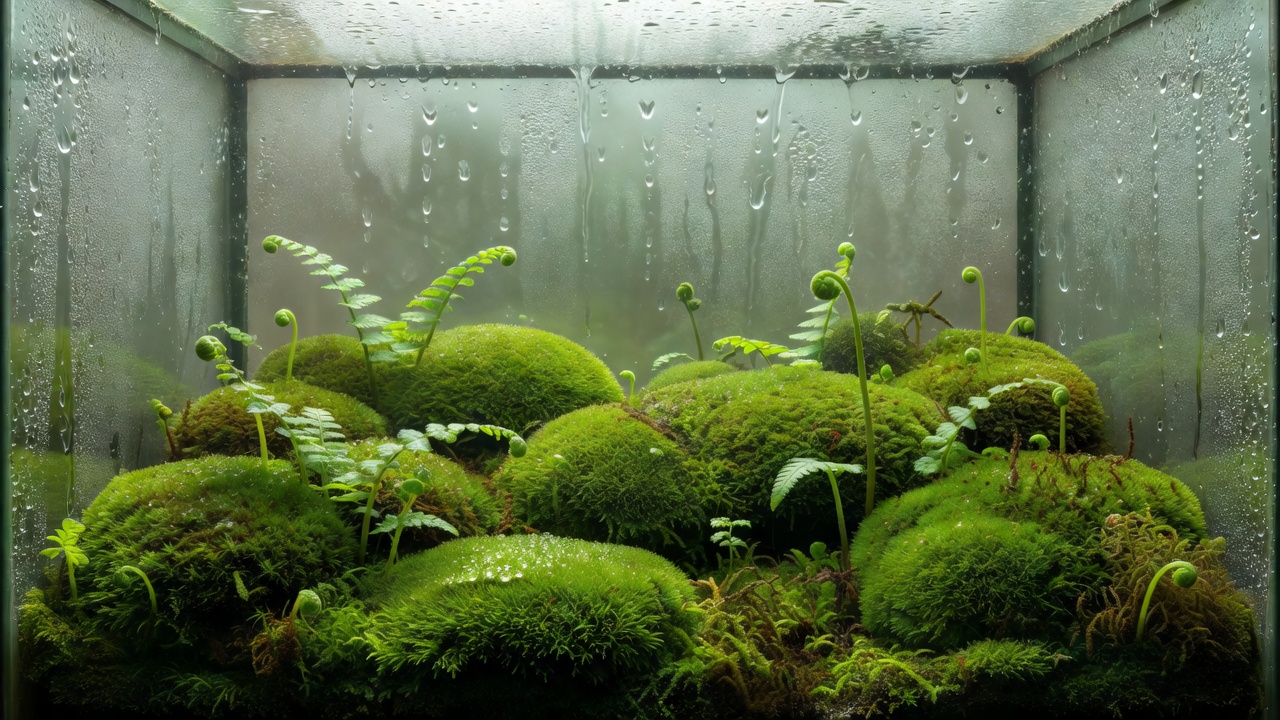
Nathaniel Bagshaw Ward's discovery was simple: in a closed glass vessel, water transpired by plants condenses on the glass and runs back into the substrate. The cycle is nearly closed. Ward tested it in 1833 by shipping two cases of British ferns to Sydney; they arrived alive after months at sea. Within decades Wardian cases were moving tea plants and rubber seedlings across empires.
For a collector, the case does three jobs. It holds relative humidity high and stable; it damps temperature swings; and it blocks the dry, moving air from heating and windows that strips moisture from thin fronds. Stability matters as much as the absolute figure. A plant kept steadily at 75% usually outperforms one oscillating between 50% and 95%.
02Humidity targets by group
Working ranges drawn from habitat data and grower records. Measure at plant height with a calibrated digital hygrometer; check it against the salt test (a sealed jar of damp table salt should read 75%).
| Group | Example | RH % | Temp °C | Light | Case |
|---|---|---|---|---|---|
| Filmy ferns | Hymenophyllum | 90–100 | 10–18 | Low | Sealed |
| Maidenhairs | Adiantum peruvianum | 60–80 | 16–24 | Medium | Vented |
| Spleenworts | Asplenium nidus | 50–70 | 16–27 | Medium | Optional |
| Staghorns | Platycerium bifurcatum | 50–70 | 15–28 | Bright | Open |
| Giant ferns | Angiopteris evecta | 70–85 | 18–28 | Medium | Greenhouse |
| Velvet begonias | Begonia pavonina | 75–95 | 16–24 | Low | Sealed |
| Jewel orchids | Macodes petola | 75–90 | 18–26 | Low | Vented |
03The build sequence
Choose the glass
A repurposed aquarium, cloche or glazed cabinet. Front-opening access matters more than shape; you will reach in weekly.
Lay a drainage layer
2–4 cm of expanded clay or lava rock, then a fine mesh to stop substrate sifting through. This reservoir prevents waterlogged roots.
Add a charcoal film
A thin scattering of horticultural charcoal. Its benefit is modest, but it helps keep the drainage layer sweet.
Mix the substrate
Equal parts orchid bark, coir or sieved leaf mould, and perlite, with a handful of sphagnum. It should hold moisture yet stay open enough to smell of forest, not of swamp.
Plant and moss
Set plants at their original depth; rhizomatous species sit on the surface. Cover bare ground with cushion moss, which buffers the surface and shows dryness first.
Light it
A full-spectrum LED strip on a 12-hour timer, mounted outside or on the lid. Never place a closed case in direct sun — it becomes an oven within an hour.
Settle and vent
Close for a week. If the glass streams constantly, crack the lid a few millimetres. A light morning mist on the glass that clears by afternoon is the target.
04Air movement and mould
The weakness of a sealed case is stagnation. Botrytis grey mould and damping-off fungi thrive in still, saturated air. Remove dead fronds at once, avoid soft compost, and consider a small 5 V computer fan on a timer for 15 minutes every few hours. Springtails (Collembola) introduced from a culture eat fungal growth and are harmless to plants.
Water with rainwater or reverse-osmosis water. Tap water leaves mineral crusts on glass and fronds, and many ferns from acidic habitats resent hard water. Feed sparingly: a quarter-strength balanced liquid feed once a month in growth.
05Outside the case
For tolerant species, group plants on a gravel tray, keep them away from radiators and draughts, and use an ultrasonic humidifier on a hygrostat. Bathrooms with a frosted window suit maidenhairs well. When a case grows too small, the next step is a cool glasshouse — the Victorian fernery, as at Tatton Park or Ascog on Bute. With the air settled, you are ready to raise new plants from spore.