01Why identification comes first
Ferns are an old lineage, and the families that survive today diverged long before flowering plants dominated. The current consensus classification, the Pteridophyte Phylogeny Group's PPG I (2016), recognises around 48 families of ferns. A collector does not need all of them, but should be able to place a plant within the right handful, because family predicts habitat, and habitat predicts care.
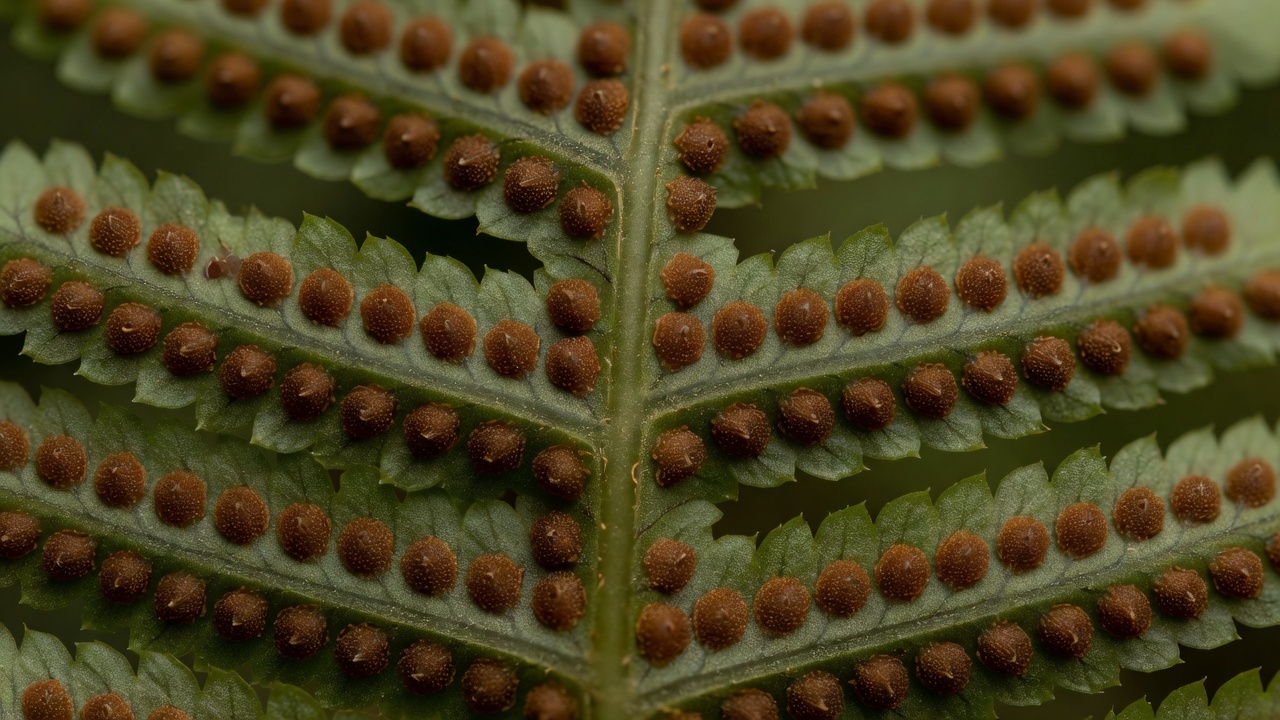
The most useful single character is the sorus: the cluster of spore cases on the underside of the frond. Its shape, position and covering (the indusium) are diagnostic. Turn every frond over before you buy. A hand lens at ×10 is the best tool on the potting bench.
02Filmy ferns — Hymenophyllaceae
Genera Hymenophyllum, Trichomanes and Vandenboschia. The lamina is usually one cell thick, without stomata and with almost no cuticle, so the frond takes water directly from the air and loses it just as fast. Sori sit at the margin in cup- or trumpet-shaped involucres, often with a bristle protruding from the mouth.
How they die: a single afternoon below about 85% relative humidity. Fronds curl, darken and do not recover. How to stop it: grow only in a sealed case, in shade, at cool temperatures (roughly 10–18 °C), on living moss or wet rock, using rainwater. Britain's Tunbridge filmy fern, Hymenophyllum tunbrigense, grows naturally on wet sandstone; that is the microclimate to copy.
03Maidenhairs and brakes — Pteridaceae
A large, varied family including Adiantum, Pteris and the desert-adapted cheilanthoids. Maidenhairs are recognised by glossy black stipes and sori tucked under a reflexed leaf margin (a false indusium). Adiantum raddianum and its cultivars dominate the trade; A. reniforme and A. peruvianum are the prizes.
How they die: a dry root-ball, followed by panic watering into a cold, compacted mix. How to stop it: an open, fine-textured mix with bark and grit, even moisture, 60–80% humidity and no direct afternoon sun. When a plant collapses, cut it to the base and keep the rhizome barely moist; regrowth is common.
04Spleenworts — Aspleniaceae
Linear sori along the veins, each with a flap-like indusium opening to one side. Ranges from the tiny wall-rue, Asplenium ruta-muraria, to the epiphytic bird's nest fern, Asplenium nidus, whose rosette funnels leaf litter into its own crown.
How they die: water pooling in the crown in cool rooms, causing rot from the centre outward. How to stop it: water the substrate, not the rosette; tolerate 50–70% humidity; keep above 15 °C. Many spleenworts produce plantlets (bulbils) on the fronds, an easy propagation route.
05Polypods and staghorns — Polypodiaceae
Round, naked sori (no indusium) in rows, or spread across specialised fertile patches. Includes Platycerium, the staghorns, with sterile shield fronds that clasp a tree and forked fertile fronds bearing velvety spore patches. Platycerium bifurcatum is beginner-friendly; P. ridleyi is not.
How they die: being potted in wet compost. How to stop it: mount on cork or hardwood with sphagnum, soak and allow to drain, give bright filtered light and good air movement. Never remove brown shield fronds; they are the plant's water store.
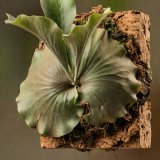
Fig. 5a — Platycerium shield frond
06Royal ferns — Osmundaceae
An ancient family with fossil rhizomes from the Jurassic that are almost indistinguishable from living ones. Sporangia are not grouped into sori but borne on separate, skeletal fertile pinnae — the "flowering" tips of the royal fern, Osmunda regalis. Spores are green and short-lived: sow within days.
How they die: drying out in containers. These are bog and streamside plants; in pots, stand them in a saucer of rainwater through summer.
07Tree ferns — Cyatheaceae & Dicksoniaceae
Trunks built from a dense mass of roots around the stem. Dicksonia antarctica from south-east Australia is the hardiest in British gardens; Cyathea (including the former Alsophila) are faster but tenderer. All Cyatheaceae are listed on CITES Appendix II.
How they die: watering the soil instead of the trunk, and frost reaching the crown. How to stop it: water down the trunk in dry weather and pack the crown with straw in winter. See sourcing before buying a trunk.
08Giant ferns — Marattiaceae
Fleshy, eusporangiate ferns with sporangia fused into boat-shaped synangia. Angiopteris evecta can carry fronds over five metres long; fleshy stipules at the frond base can be used for propagation. They need warmth (above 18 °C), 70–85% humidity and space few homes offer. Next: building the air these families need.